.jpg)
[AUTO](VC) Limit Break 4 (This ability is active if you have four or more damage):[Soul Blast(9)] When this unit attacks a vanguard, you may pay the cost. If you do, draw two cards, and choose up to two of your «Genesis» rear-guards, and [Stand] them.
[AUTO](VC): During a battle that this unit is attacked, when your «Genesis» guardian is put into the drop zone, put that card into your soul. This ability cannot be used for the rest of that battle. (If two cards or more are put into the drop zone at the same time, you may only put one of them into the soul)
This card is so outrageously simple.
How to use this card
.jpg) Wisdom Keeper, Metis is probably Yatagarasu's best friend. Assuming you break ride into this card about around turn 5, the cards you've ridden make up 3 Soul, and Metis' Soul Charge should amount to 5. Count 3 more thanks to Metis' skill, and you're looking at maybe only 1 card you need to Soul Charge outside of what you're already doing. Finally, since almost all Genesis Starting Vanguards generally add at least 1 Soul, the reality is that with Metis, you have almost nothing to worry about, at least in terms of being prepared to use the Limit Break. The only problem with this picture is that Metis essentially is carrying Yatagarasu through mostly just its own efforts, so it kind of seriously sucks without Metis then. Assuming you aren't an idiot that doesn't know how to guard early and competently, you're still looking at 4 Soul to begin with before you get to the late game, thanks to Yatagarasu's secondary skill. After that, the starters are largely going to influence how the card plays. These next analyses all assume you ride immediately into Yatagarasu, and your deck contains some combination of these four cards.
Wisdom Keeper, Metis is probably Yatagarasu's best friend. Assuming you break ride into this card about around turn 5, the cards you've ridden make up 3 Soul, and Metis' Soul Charge should amount to 5. Count 3 more thanks to Metis' skill, and you're looking at maybe only 1 card you need to Soul Charge outside of what you're already doing. Finally, since almost all Genesis Starting Vanguards generally add at least 1 Soul, the reality is that with Metis, you have almost nothing to worry about, at least in terms of being prepared to use the Limit Break. The only problem with this picture is that Metis essentially is carrying Yatagarasu through mostly just its own efforts, so it kind of seriously sucks without Metis then. Assuming you aren't an idiot that doesn't know how to guard early and competently, you're still looking at 4 Soul to begin with before you get to the late game, thanks to Yatagarasu's secondary skill. After that, the starters are largely going to influence how the card plays. These next analyses all assume you ride immediately into Yatagarasu, and your deck contains some combination of these four cards.Aiming for the Stars, Artemis - Personally, I don't recommend any ride chain where it's not necessarily needed because it introduces a lot of probability where it doesn't have to be. With that in mind however, this probability also includes collecting as much as 7 Soul by turn 3, which considering Yatagarasu's secondary skill, nearly completely does all of the Soul building necessary for the Limit Break to activate.
.jpg) Realistically speaking however, there are a lot of numbers to take into consideration. There's a 49.8% chance to ride both the Grade 1 and Grade 2, a 26.5% to just ride the Grade 2, a 4.2% chance to only ride the Grade 1, and a 17.8% chance to miss them both entirely. In other words, the possibility to start turn 3 with 7-8 soul 1/2 the time, 4 soul 1/4 of the time, and 3-2 the rest. In the case of 7-8 soul, it's mostly self explanatory as to how that turns out. Getting 4 Soul however is different. Metis alone should be more than enough to get 9 Soul without outside help, but in the case of missing Metis, making up 5 Soul will be a bit of a challenge. Yatagarasu's skill should generally be enough to carry you to about 6 Soul in total by the late game, but ultimately, Tatsutahime is your most reliable means of getting you up to 9 soul. Sahohime could potentially do the job, but pressure doesn't exactly favor Rear Guards and Rear Guards alone. If caught at 3, Cumin should be more than enough to help here. However, being caught all the way at 2 Soul is going to be far harder to make up for, as your most reliable means of generating that 5 Soul, Tatsutahime, runs into Counter Blast issues as the late game locks out the Vanguard lane's means of pressure, and almost completely shutting down Sahohime. You should only need 1 extra Soul if you're able to use Metis in this situation, but in the worst of worst case scenarios, or similar scenarios such as the opponent having the gall to guard Artemis and locking you out of a lot of necessary soul, you're going to run into a number of problems trying to get around this.
Realistically speaking however, there are a lot of numbers to take into consideration. There's a 49.8% chance to ride both the Grade 1 and Grade 2, a 26.5% to just ride the Grade 2, a 4.2% chance to only ride the Grade 1, and a 17.8% chance to miss them both entirely. In other words, the possibility to start turn 3 with 7-8 soul 1/2 the time, 4 soul 1/4 of the time, and 3-2 the rest. In the case of 7-8 soul, it's mostly self explanatory as to how that turns out. Getting 4 Soul however is different. Metis alone should be more than enough to get 9 Soul without outside help, but in the case of missing Metis, making up 5 Soul will be a bit of a challenge. Yatagarasu's skill should generally be enough to carry you to about 6 Soul in total by the late game, but ultimately, Tatsutahime is your most reliable means of getting you up to 9 soul. Sahohime could potentially do the job, but pressure doesn't exactly favor Rear Guards and Rear Guards alone. If caught at 3, Cumin should be more than enough to help here. However, being caught all the way at 2 Soul is going to be far harder to make up for, as your most reliable means of generating that 5 Soul, Tatsutahime, runs into Counter Blast issues as the late game locks out the Vanguard lane's means of pressure, and almost completely shutting down Sahohime. You should only need 1 extra Soul if you're able to use Metis in this situation, but in the worst of worst case scenarios, or similar scenarios such as the opponent having the gall to guard Artemis and locking you out of a lot of necessary soul, you're going to run into a number of problems trying to get around this.Fun thing to note though, the ride chain if fully successful will load you up with 7-8 soul by turn 3. Ride Metis, and Break Ride, and you're looking at about 13-14 soul by the late game. Maybe through Break Riding twice or getting especially lucky with your Soul Charging support, and it may open up the opportunity to use Yatagarasu twice. Granted, you've got to jump through a lot of hoops, and you're going to end up with a lot of excess soul if you aren't able to utilize this fully, but if you are willing to risk the numbers and use Artemis in the first place, it's just something to consider.
 Battle Maiden Amenohoakari - One of the seemingly more reliable starters, it should easily be able to get you to 9 Soul with Metis meaning you have very little to worry about when it comes to including more Soul support to help supplement your plays. The only problem with this particular starter is that it more or less may class with Tatsutahime, as both of their most optimal spots are behind the Vanguard, easily leading to have to pick one or the other. This causes a slight hiccup when playing without Metis, as with Amenohoakari and Yatagarasu, you're only looking at about 6 Soul by turn 5. If the game manages to last longer than this, Soul shouldn't be a problem, but because resources are finite, this isn't a reliable strategy to fall back on. Unfortunately, without Tatsutahime, you would need to work quite a bit harder to make up that 3 Soul, and even with Sahohime at 4 and its capabilities should you ride it, off scenarios such as missing it on the ride up or the opponent guarding can lead to problems. While Yatagarasu is still a viable option should you be able to get your Soul somehow, I would highly suggest that if Amenohoakari is being used that you either dedicate the build entirely between Metis and Yatagarasu, or back off and allow use cheaper and more flexible back up Vanguards to allow you more options if things start to go south.
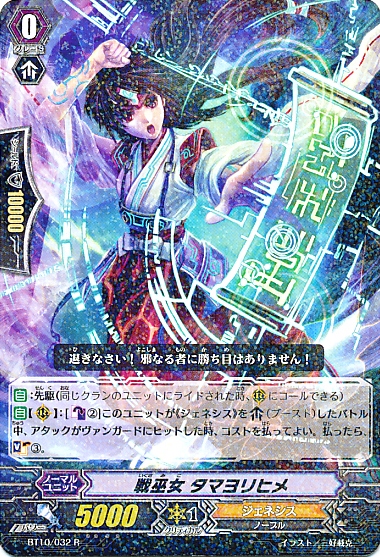 Battle Maiden Tamayorihime - Once again, Tatstahime gets shafted.
Once again, there's not much particularly special happening when this card works with Metis past the near guaranteed setup. On the other hand, without Metis, that's about 7 Soul in total. It's also far less dependent on staying on the field for every turn after having ridden the Grade 3, and can activate as early as turn 2 should you have access to the Counter Blasts, ultimately making the card far more flexible than Amenohoakari in terms of getting it off the field to try to do other things. Unfortunately, the Counter Blast cost to activate its skill sort of disallows Tatsutahime to do much at all, unlike Amenohoakari which would only require it to be in the Rear Guard and at least has the potential of more easily allowing double Rear Guard columns. More to the point, this means that Existence Angel will have to take up the role of topping off that last bit of Soul, or Cumin would need to combo off something else in order to make it. In the end, a more focused build specifically on Yatagarasu and Metis is just a little more feasible with Tamayorihime.
.jpg) Witch of Prohibited Books, Cinnamon - Similar to Tamayorihime in that it will generally give you 7 Soul by turn 5 or so, it has one major advantage over the other starter; Counter Blasts. Without needing to hamstring Tatsutahime by taking up its resources, you once again have access to one of the more reliable means of generating Soul. In fact, in the off occasion that even if you guarded properly you are still taking more damage than you can deal with, this actually means almost reliably being able to set off Yatagarasu's Limit Break by as early as turn 4.
Witch of Prohibited Books, Cinnamon - Similar to Tamayorihime in that it will generally give you 7 Soul by turn 5 or so, it has one major advantage over the other starter; Counter Blasts. Without needing to hamstring Tatsutahime by taking up its resources, you once again have access to one of the more reliable means of generating Soul. In fact, in the off occasion that even if you guarded properly you are still taking more damage than you can deal with, this actually means almost reliably being able to set off Yatagarasu's Limit Break by as early as turn 4.Unfortunately, this card faces one glitch that the others don't need to deal with; card advantage. While the reality is that only one card is lost, it's the Vanguard booster that needs to be replaced, which leads to a few glitches. On one hand, if you have a Grade 1 in hand and only one Grade 1 in hand, and you decide to use Cinnamon's skill right then and there, chances are you aren't using your cards as proficiently as possible; doubly so if you have no other boosters yet, as you lose out on quite a bit of advantage granted by triggers, which is something you need to deal with. On the other hand, if you don't have a Grade 1 in hand and you go ahead and use Cinnamon, in the off chance that you don't draw another Grade 1 or such, you will be missing your Vanguard booster, which is a huge loss considering how important a full powered Vanguard attack is for your forward leverage, and is now something you really have to deal with. All in all however, you're trading some proficiency in the card's actual usage for far more freedom with CB and more flexible deck choices, so if you can play around these quirks, Cinnamon can definitely do her job.
With all of that out of the way, Yatagarasu herself is extremely simple to use assuming you aren't an idiot, so going in depth about her will be extremely redundant. Along with this, I only used Metis as an example as she gives the easiest access to Yatagarasu's Limit Break without much hassle at all, but you can opt to use a different Break Ride if you think the rest of your deck's Soul support can keep up. In the end however, what really makes Yatagarasu complicated and warrants the most attention out of the player is the deck composition and being able to properly capitalize off the starter, as smart decisions will pay off in the end.
How to Fight Against This Card
 While the opponent is using, say, Metis, it will be damn near impossible to avoid having to deal with the Limit Break should the opponent draw into Yatagarasu. Because of this, there isn't exactly a point of prioritizing anything else than to deal with the late game mess Yatagarasu is going to cause. With this in mind, there's really only one goal when trying to fight against the deck; don't get caught up in the Limit Break. Luckily, there are some quirks about the deck that should help you outmaneuver Yatagarasu, most of these riding on how the deck as a whole is/must be designed. Depending on how dedicated the deck is to picking up Yatagarasu without Metis, you could easily see a virtually vanilla deck coming up to face you. With so much of their deck designed around catering to Yatagarasu's soul, and said soul already being fulfilled by Metis, it means that all their Soul Support units (and thus, pressure units) are rendered virtually useless; this goes for before and after Yatagarasu's Limit Break, generally. What this basically means is that there is only one thing from the deck you need to worry about, Yatagarasu's Limit Break. Take every early game and mid game advantage you can take, whether it be through early guarding, scaling your field to odd stages, and taking full advantage of whatever skills that you have access to that early in the game. Since Yatagarasu's Limit Break is otherwise inevitable, your goal is to create as much distance as possible between you and the opponent so that even after Yatagarasu Limit Breaks, you will be able to pull through. At that point, their deck will once again be rendered virtually unable to do anything other than very basic moves, which almost every deck in the game - should you have played properly up to this point- will be able to outplay and generally beat.
With all of that out of the way, there are the scenarios that Metis won't be carrying the deck. Because of the large amount of clues there should be as to whether or not the opponent is running a backup Vanguard, along with the fact the opponent probably will ride it turn 3 anyway, let's focus more on when Yatagarasu has to focus on Soul Building support to get to its Limit Break. With this in mind, the most obvious cue to take note of is how much pressure plays a role behind any possible advantage generated. In other words, if your deck has the defensive/hand advantage capabilities to constantly defend from a pressure vanguard, a similar concept will be able to counteract Yatagarasu's main forms of generating Soul. While I can't provide examples due to every scenario being otherwise extremely specific and situational, knowing your own deck's capabilities and whether or not expending mid game resources for the late game or vice versa will best fit your deck will be the key here.

My only question here is, why would you run Yatagarasu with any kind of Break Ride? Her second skill is what makes soulcharging so ridiculously easy, plus having Sahohime as a Turn 2 ride and as rear-guards really starts it off already.
ReplyDeleteHer second skill is capped to essentially one soul per turn, and that's assuming you can always guard at least once every turn. Similarly, Break Rides can Soul Charge once per turn. Along with this, Metis in particular gives you even more soul to work with. Finally, assuming turn 2 Sahohime rides runs into minor consistency problems, especially if we also consider immediately riding into Yatagarasu like you're suggesting, so while yes, you have a point under specific situations, Break Rides simply help consistency as a whole, as they give you another option to build Soul even without Yatagarasu or her slight gimmicks, and relieves some consistency problems.
DeleteYatagarasu's skill is once per battle, though, therefore the amount of soul you get is equal to the number of times you guard per turn. Meanwhile, the Break Rides are a static +1 soul each turn (not factoring Amenohoakari). Late game doesn't matter since you'll be on Yatagarasu for the rest of the game, Break Ride or not, and you'll be amassing about 2-3 soul per turn given how much you would be guarding for during late game.
DeleteTo be honest, guarding once every turn is rarely possible, given that you will approximately have one trigger among the +3 that the game's mechanics (Draw + Twin Drive) give you each turn.
Sahohime is best as a turn 2 ride, but she gives off the pressure nonetheless as a rear-guard.
Thanks for the explanations by the way. I'll actually ask the following: if I were to run Yatagarasu without any Break Ride, what other Grade 3 would be best to include?
Considering that most mid game guards tend to utilize specifically triggers, wouldn't the logic follow that if you only get maybe 1 trigger per turn that you will generally tend to guard with that 1 trigger per turn? You know, essentially capping the skill to one Soul Charge per turn? Like, I get your point about the late game, mostly, but do realize that (while I forgot to state it directly, sorry) I'm focusing on the mid game here, and in that case the Break Rides only succeed to do just as well (if not better in the case of Metis) at building Soul through the mid game.
DeleteThe way I see it is, especially if your deck is that dedicated to Yatagarasu, you're going to be much more heavily focused on building Soul than having a really well rounded deck. This in mind, the Grade 3 in question needs to be well rounded and mostly self functioning. Think vanguards like Artemis whose drawing capabilities are a near universal out to everything, and avoid vanguards like Fortuna, who in this case is far more chance based and less capable on her own.
Once again, thank you for your replies.
DeleteMy only argument for Yatagarasu as a midgame vanguard now is the following:
Break rides soulcharge once per attack, and we assume that we guard once per turn, therefore one soul per turn solely due to the vanguard abilities, correct? What I'm thinking about is this: If Yatagarasu allows the soul to come out from the hand, does that not mean that said card becomes a resource AFTER using it to successfully guard (and probably as a checked trigger that gives you the bonuses)? Compared to the break rides, you still get the chance to use the card, and storing it up as a resource for later use, whereas the break rides will render the card usable only as soul resource, assuming that said card is a trigger.
Even when you don't guard with triggers, interception with cards like Chamomile and Grappa, as well as guarding with extra Valencias and Melissas (provided that the aforementioned cards are ran) also give you latent bonuses that occur during late game. The break rides simply can't do the same thing, and using them means you soulcharge entirely at random.
And don't forget the triggers you may have ended up with in your starting hand, which you can utilize to guard slightly more attacks during midgame. If the opponent only launches one-stage attacks at you and you can afford the guard, that's potentially even more soul.
I guess that's it. I look forward to your reply.
I understand where you are coming from, but it seems that all your arguments revolve around specific examples.
DeleteNow, don't get me wrong, I understand the value of specific examples, but do realize you are talking to the blogger with a probability based priority at looking at things, and more specifically, I want to build for the average set. Once again, your arguments make sense in their specific scenarios, but are largely moot overall over the course of a large amount of turns/games. I'd also like to return to the argument that having Break Rides helps optimal turn 3 riding consistency, which is an element outside of just soul and resource management that we're arguing here. It's simply just one more factor to consider looking at these things overall.